

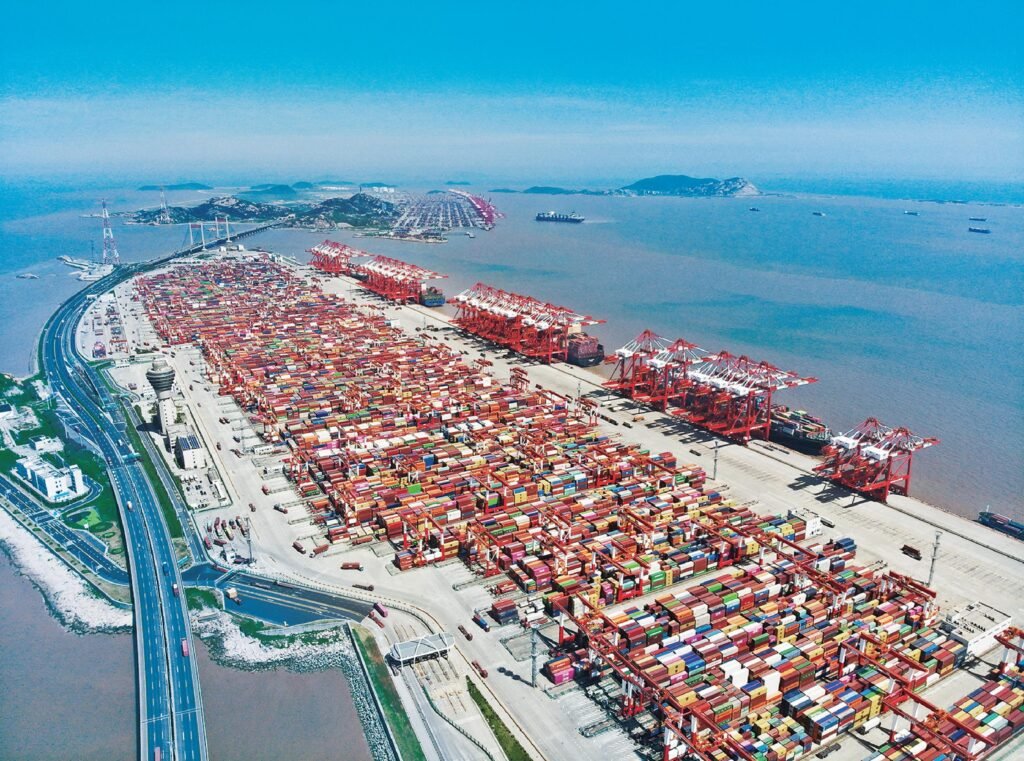
If you have ever unboxed a new smartphone, assembled a piece of flat-pack furniture, or worn a piece of fast-fashion clothing, there is an almost 100% certainty that it passed through one of China’s colossal container ports. In the complex machinery of global trade, these ports are not simply docking stations — they are the pistons that keep the engine of the world economy running.
While many people look to Wall Street or Silicon Valley for economic indicators, the real pulse of global commerce can be found along China’s coastline. In 2025, China solidifies its dominance in maritime logistics, with seven of the world’s top ten busiest container ports located within its borders. From the sprawling megaport of Shanghai — which has held the title of the world’s busiest container port for 16 consecutive years — to the rapidly expanding hubs of the Beibu Gulf, these maritime giants handle over 260 million TEUs (Twenty-Foot Equivalent Units) annually.
In this post, we will rank the top 10 Chinese ports by container throughput. This ranking measures the number of containers handled, indicating a port’s role in global manufactured goods trade.
1. Port of Shanghai
★ Location: Yangshan deep water port, Pudong New District, Shanghai
★ Throughput: World’s largest and busiest container port, and has held the top spot for 16 consecutive years.
★ Established: 1842
★ Main Routes: Major routes to Europe, North America, Japan and Southeast Asia
2. Port of Ningbo-Zhoushan
★ Location: Beilun District, Ningbo & Zhoushan City, Zhejiang Province
★ Throughput: Top 3 globally in cargo throughput, particularly strong in bulk cargo handling.
★ Established: 2006 (Ningbo merged with Zhoushan)
★ Main Routes: Connects with Europe, the Middle East, Southeast Asia and Africa.
3. Port of Shenzhen
★ Location: Nanshan, Yantian, Bao’an District, Shenzhen, Guangdong Province
★ Throughput: One of China’s busiest container ports, ranking in the top 5 globally for container volume.
★ Established: 1980 (Shenzhen Special Economic Zone)
★ Main Routes: Primarily to HongKong, Southeast Asia and North America.
4. Port of Qingdao
★ Location: Huangdao District, Qingdao, Shandong Province
★ Throughput: Top 10 globally, known for large container and bulk cargo handling with stable, efficient operations.
★ Established: 1892
★ Main Routes: Connects mainly to Japan, Korea, Southeast Asia and Europe.
5. Port of Guangzhou
★ Location: Nansha and Huangpu District, Guangzhou, Guangdong Province
★ Throughput: Among China’s top 5 ports by cargo volume, vital for domestic and international trade.
★ Established: 1916
★ Main Routes: Major routes to Southeast Asia, Europe and Africa.
6. Port of Tianjin
★ Location: Binhai New Area, Tianjin
★ Throughput: One of China’s top 10 ports, handling large volume of container and bulk cargo for North China.
★ Established: 1949
★ Main Routes: Connects to Europe, the Middle East and East Asia.
7. Port of Xiamen
★ Location: Haicang and Xiang’an District, Xiamen, Fujian Province
★ Throughput: Ranked in the top 10 for container throughput, crucial for trade with Taiwan and Southeast Asia.
★ Established: 1982
★ Main Routes: Primarily to Taiwan, Southeast Asia and Japan.
8. Port of Suzhou (Inland Port)
★ Location: Zhangjiagang, Changshu, Taicang, Suzhou, Jiangsu Province
★ Throughput: A leading inland port in China with high cargo throughput, mainly for industrial goods.
★ Established: 1992
★ Main Routes: Connected by the Yangtze River to global shipping lanes.
9. Port of Beibu Gulf
★ Location: Qinzhou, Fangchenggang & Beihai, Guangxi Zhuang Autonomous Region
★ Throughput: Rapidly growing in container and bulk cargo handling, key for Southeast Asia trade
★ Established: 2008 (Qinzhou port expanded)
★ Main Routes: Focus on trad with ASEAN countries and South Asia.
10. Port of Rizhao
★ Location: Donggang District, Rizhao City, Shandong Province
★ Throughput: Significant for bulk cargo, especially coal and iron ore, supporting steel industries
★ Established: 1986
★ Main Routes: Bulk shipping to Northeast Asia, Europe and Oceania.
As we have seen, China’s top container ports are far more than just concrete docks and towering cranes. They are the strategic nodes of a highly integrated, technology-driven logistics network that powers the nation’s manufacturing might. While the numbers are staggering — Shanghai alone handling over 55 million TEUs — the story goes deeper than sheer volume. It is a story of deliberate infrastructure planning, dividing the coastline into specialized port groups that serve the industrial heartlands of the Yangtze River Delta, the manufacturing corridors of the Pearl River Delta, and the resource-heavy regions of the Bohai Rim.
However, the landscape of global shipping is never static. As we look toward the future, these ports face challenges ranging from geopolitical tensions and supply chain reconfigurations to the urgent need for carbon-neutral operations. Yet, with continuous investments in automation, artificial intelligence, and deep-water berths, China’s ports are not just maintaining their lead — they are redefining what a “smart port” looks like for the rest of the world. These ten ports remain the unsung heroes of our modern, connected age — and they are only just getting started.